
On May 30th 2023 we got a call from Lucia, a home owner in Balbriggan, North Co Dublin about a honey bee removal. Her home has a two-story extension with a flat roof on the back of the house. She explained that a previous colony of bees had been removed from the same spot and another had decided to occupy it this year. From the videos and pics she sent, it did seem to be two separate colonies either end of the flat roof but we would have had to investigate it to be sure.
Upon inspection I was able to determine it was just one colony. They were entering at the corner of the flat roof and were most likely building between the joists above the upstairs bathroom. I was able to hear and feel them moving just above the plaster board and pinpoint the exact area they were occupying. It was apparent the best way to remove them was from the inside. To do that we would need to close ourselves in the bathroom and remove a section of plaster board to get access. Lucia was very understanding and was happy to get repair work done afterwards. Saving the colony itself was important to her.
It proved a bit of a challenge setting up and fitting all of our equipment in, bathrooms aren’t generally the most spacious of rooms but we got everything in with enough space to move around.
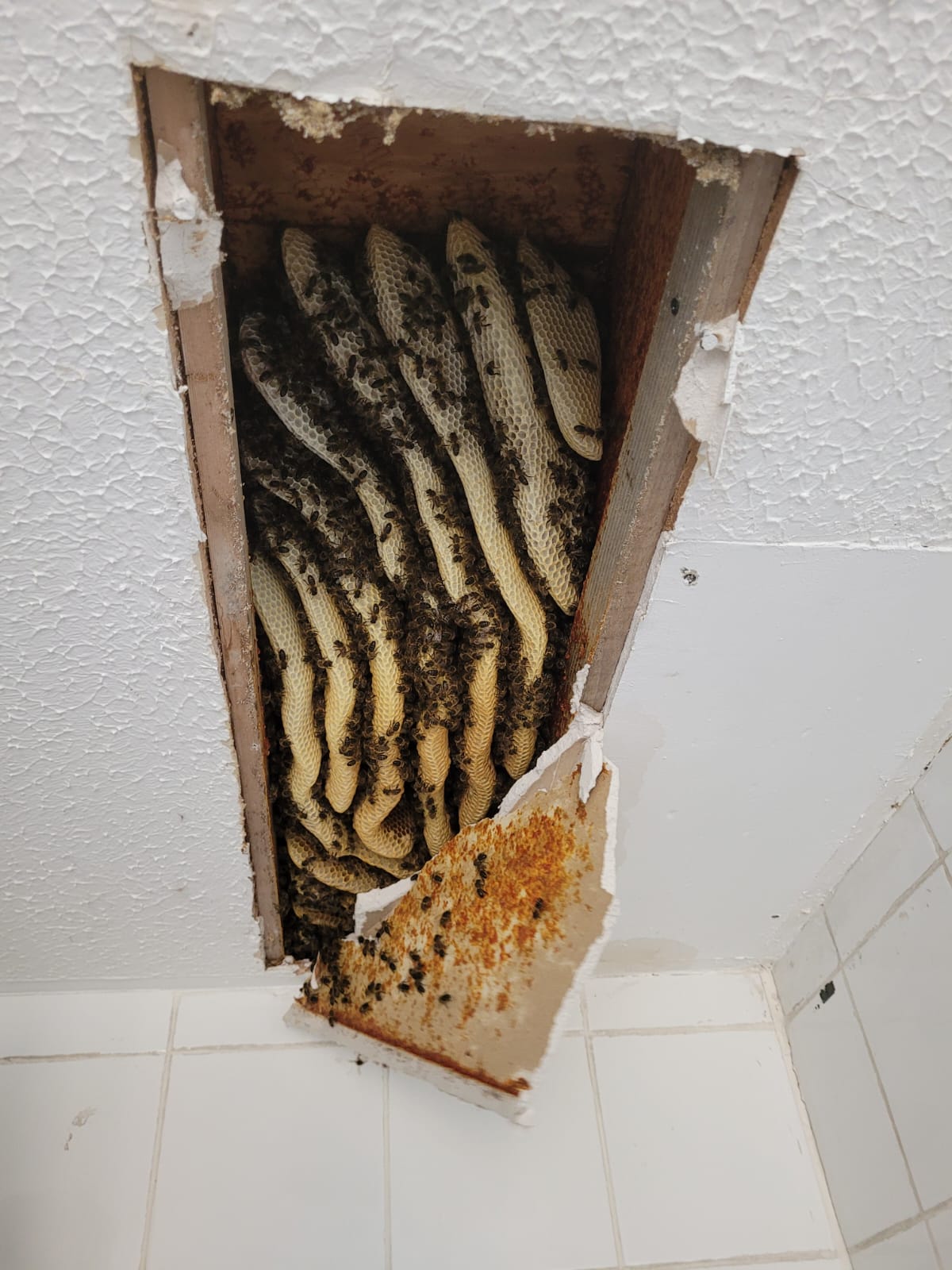
To start gaining access we removed two small squares of plasterboard held up by screws from the last removal. This colony had set up in the joist space to the left of the previous one, going by the old comb to the right. We had the cut away a bit more plaster board to get to the full reach of what they had build and expose the whole hive.
Accessing the colony from the bottom allowed us to see the intricately built comb and identify how we could remove them with causing the least mess possible. Slowly we removed brood comb while sucking the bees into our bee vac. Usually when we are doing a removal like this we don’t see the queen bee because she gets sucked up with the bees on the brood comb, but in this instance this lady wanted to be seen. I was going to do a glove change and there she was sitting on the box calmly watching us. I gently picked her up and put her in a cage so she didn’t get hurt.
Once the brood and majority of the bees were out we carefully started taking out the honey. Comb and honey, as new as this, is very messy because it falls apart and runs all over the place with just a small touch. At one point it was raining honey on us but we kept the drips to a minimum.
With many glove changes we were also able to cleanly save some of the honey for Lucia which tasted amazing. We got all the bees we could into the bee vac and re-introduced the queen before shutting everything down.
With the removal complete we scrapped any wax/propolis from the area, painted the timbers to mask any smell, we put up temporary boards covering the hole and injected the cavity with expanding foam. The facia and soffits of the flat roof are going to be replaced and sealed so hopefully this is the last removal from that roof.
The last pictures are of how the colony looks now. The queen was out and laying within a few days and the colony is busy rebuilding in their new home. The colony itself is Amm (native Irish honey bee), they are nice docile bees and strong builders so we are confident they will build up enough to survive the winter months (if the rain ever lets up).
Big thanks to Lucia for saving this colony of essential pollinators and the cups of coffee to fuel us through it.
To learn more about the native Irish honey bee visit Bee Conservation
